CPA is short for cost per action or cost per acquisition. It tells you how much you spent to achieve one goal — a lead, a conversion, or a sale — for your business.
For example, if your goal is for someone to buy a product or book your services, CPA tells you how much ad spend it took for that action to happen. Google Ads lets you optimise campaigns directly against a target CPA.
The calculator below works out the CPA of your campaign from your number of conversions and your total cost.
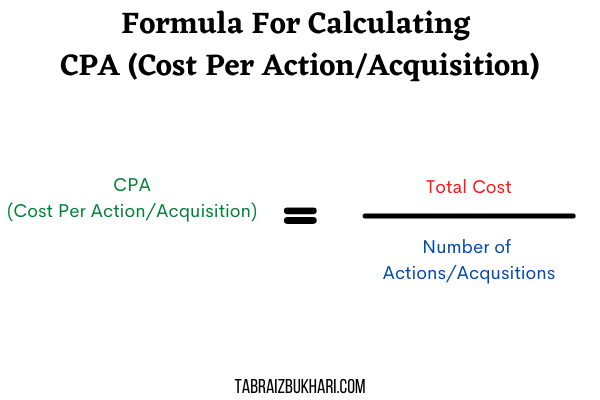
Cost Per Action Formula
The formula is straightforward: divide total cost by the number of actions completed. If your ad spend was $200 and that budget produced 20 actions, your CPA is 200 divided by 20 — a CPA of $10.
What Counts as a Good CPA?
CPA is only meaningful next to the value of the conversion. A $60 CPA is excellent if each customer is worth $600 over their lifetime, and disastrous if they’re worth $40. Before you judge a CPA figure, work out two numbers: what a conversion is worth to you, and what your target margin is on that value.
It’s also worth separating a lead CPA from a sale CPA. If 1 in 5 leads becomes a customer, a $20 cost per lead is really a $100 cost per customer — and that’s the number that determines whether the campaign is profitable.
How to Bring Your CPA Down
- Improve conversion rate first. CPA falls the moment more of your existing clicks convert — usually cheaper than trying to buy cheaper clicks. Check your rate with the conversion rate calculator.
- Cut wasted spend. Search term reports and negative keywords remove clicks that were never going to convert.
- Raise Quality Score. Better ad relevance and landing page experience lower your cost per click, which flows straight through to CPA.
- Reallocate budget. Shift spend from high-CPA ad groups toward the ones already performing rather than trying to rescue everything.
- Give smart bidding enough data. Target CPA bidding needs a reliable conversion history before it performs well. Setting an aggressive target too early usually just throttles delivery.
Frequently Asked Questions
Where is CPA most commonly used?
Most major ad platforms offer CPA-based strategies. Google Search Ads, YouTube Ads, Facebook Ads, Instagram Ads, and Bing Ads all let you bid toward a cost per action target.
If I’m not using a CPA bidding strategy, is CPA still worth tracking?
Yes. Even if you’re bidding on CPC or CPM rather than actions, CPA remains one of the most informative metrics you have. In any campaign built around getting people to complete an action, what ultimately matters is how many completed it and what each one cost you.
What’s the difference between CPA and CPL?
CPL — cost per lead — is a specific type of CPA where the action being counted is a lead rather than a sale. CPA is the broader term and can refer to whichever action you’ve defined as your conversion.
How is CPA different from CPC?
CPC is what you pay for a click; CPA is what you pay for a completed action. A campaign can have a very low CPC and still show a poor CPA if those cheap clicks rarely convert — which is why the two should always be read together.